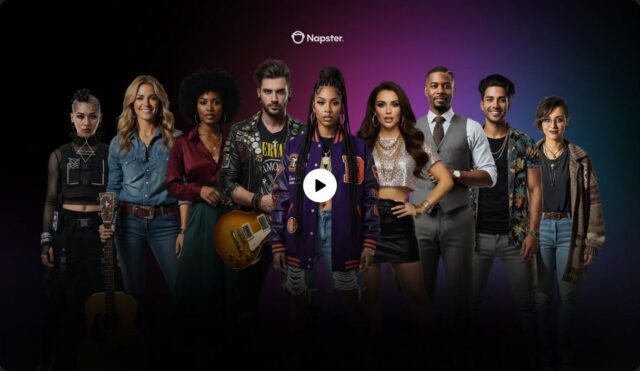
Napster has launched a redesigned mobile entertainment app for iOS and Android, focusing fully on AI generated content and real time creation. The company says the app is built for participation rather than streaming, a notable change for a brand that once defined peer to peer music sharing and now describes itself, with a straight face, as “an innovation company powering the next generation of embodied and agentic AI.”
The new app acts as a single mobile hub for AI driven music, podcasts, wellness audio, and collaborative creative tools. It does away with traditional record label catalogs and fixed playlists in favor of adaptive content shaped by user interaction. Napster sees this hub as one where listeners and creators occupy the same space.
Napster: From MP3 to AI
For anyone of a certain age, Napster’s re-imagining is certainly interesting. It began in the late 1990s as a file sharing service that disrupted the music industry by making MP3s easy to trade online.
Legal pressure eventually shut that version down, and the name passed through several owners as the service tried subscriptions, licensed streaming, and brand revivals. The current incarnation bears little resemblance to its origins, aside from the name and a recurring interest in upsetting established models.
SEE ALSO: Universal Music Group and Nvidia partner on AI for music creation and discovery
Inside the new app, users interact with what Napster calls Companions, conversational AI agents designed to assist with creation and exploration. The catalog is made up entirely of AI generated audio rather than licensed recordings. Users can also co-create music and other audio directly in the app, working alongside AI artists instead of browsing finished tracks.
The company wants us to think of this as a move away from passive consumption. John Acunto, CEO of Napster, said, “Napster was born to break boundaries, and we’re doing it again. We see this as a declaration that the age of passive consumption is over. Fans aren’t here to be fed a playlist. They’re here to co-create, to fuse their identity with AI artists in real time, and to shape the soundtrack of a new era.”
As well as mobile apps, the same system powers a web version and a macOS app. Those versions can also connect with Napster View hardware, which allows interaction with AI experts on a dedicated second screen.
Music is generated in the app across genres and moods based on user prompts and preferences. Podcasts are hosted by AI personalities that adapt based on audience interaction. Wellness audio includes ambient soundscapes, sleep focused sessions, and adaptive meditation experiences that respond in real time.
One feature Napster is leaning heavily into is “AI artist” collaboration. Users can co write, co produce, and co perform music with AI artists, resulting in mixed and mastered tracks that can be shared or published within the platform, something Napster says removes technical and financial barriers that have traditionally limited music creation.
Rather than licensing music from labels, every piece of content is generated through AI models and composition engines.
Edo Segal, Chief Technology Officer of Napster, said, “Napster is once again shaking up consumers’ relationship with music, this time by giving every fan a chance to get in the studio with artists and be a creator. This is the first platform where the content is as dynamic as the listener, turning every interaction users have with an AI artist into a unique performance.”
What do you think about Napster’s latest reinvention? Let us know in the comments.