A record of an experienced team’s decisions can help others understand its work. The useful cases preserve the evidence and the outcome, including the times the team got it wrong.
Sponsored content from SourceX
Picture your most experienced service lead handling a case nobody else could crack. Colleagues remember the result. What they forget is the judgment it took: the check she ran first, the obvious fix she ruled out, the exception she got approved and why.
Some of that judgment may survive in the ticketing system, engineering tracker and approval trail. Check what was actually recorded; a successful outcome does not mean the archive captures the thinking that led to it.
Epoch AI’s June 2024 analysis projected that the effective supply of public human-generated text could be fully used between 2026 and 2032 if the study’s scaling trends continued. The forecast helps explain interest in other data sources, but does not prove a buyer needs your team’s records. Their value depends on what they document and the rights available for the proposed use.
Employee knowledge data licensing is an awkward name for a specific proposal: licensing approved work records for AI training or evaluation. A company does not own every idea, message or personal detail simply because it appears in an employee’s account.
THE SHORT VERSION
- Your systems may preserve expert decisions. Check which evidence, actions and outcomes were actually recorded.
- The asset is the work, not the people. Roles can stay; names and private details should not.
- Before any license, decide what you’re keeping for onboarding and internal AI, and what you’re committing.
A record is useful when it preserves the evidence, decision and outcome. Check what the archive actually contains.
Where does expert judgment show up in company records?
Start with a workflow where experience reliably changes the outcome. Good candidates include:
- Diagnosing a stubborn software issue
- Handling a service exception the policy didn’t anticipate
- Interpreting an internal procedure in a gray-area case
- Deciding when to escalate rather than act
Then look at what the record actually preserves. A note that says “handled by senior staff” tells an outsider almost nothing. A connected case that shows the context, the options considered and the action taken tells them a great deal.
That’s also how a business describes its expertise credibly, with evidence instead of a speculative valuation of “institutional knowledge”.
Is every past decision worth learning from?
No, and pretending otherwise is the fastest way to lose a reviewer’s trust. Archives contain mistakes, abandoned approaches and rules that changed. Some decisions only look clean because a later summary smoothed over the uncertainty.
Ask a seasoned operator to pressure-test the collection with three questions. Can they tell a genuine resolution from an administrative closure? Do they know which policy version applied at the time? Can they spot what information was missing?
A dataset can be useful with documented limits. It becomes hard to trust when every case is presented as excellence.
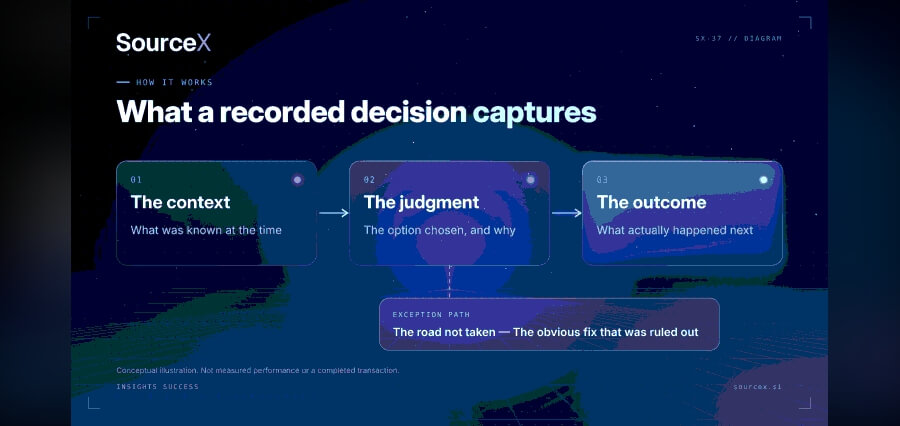
Conceptual: a useful record keeps the context, the choice (including what was ruled out) and the result connected.
How do you protect employees in a data license?
Separate roles from identities. A reviewer may need to know that a supervisor approved an action. They don’t need the supervisor’s name, contact details or unrelated messages.
Look beyond names. An unusual role, event or project can still identify a person after direct identifiers are removed. De-identification can reduce that risk but does not, by itself, establish anonymity. Review employee-related obligations, customer commitments and third-party rights for the actual collection and use; exclude material that cannot be appropriately released.
Leaders who handle this well tend to say so openly inside the company. Your team should hear about it from you, not from a rumor.
What are you giving up, and what do you keep?
The same history that might interest an AI developer also powers onboarding, continuity planning and your own internal AI tools. Weigh a license against those uses before you weigh the payment.
Read the rights terms closely: permitted uses, exclusivity, duration and onward rights. Keeping your original records doesn’t answer every question about what you’ve granted over a selected dataset.
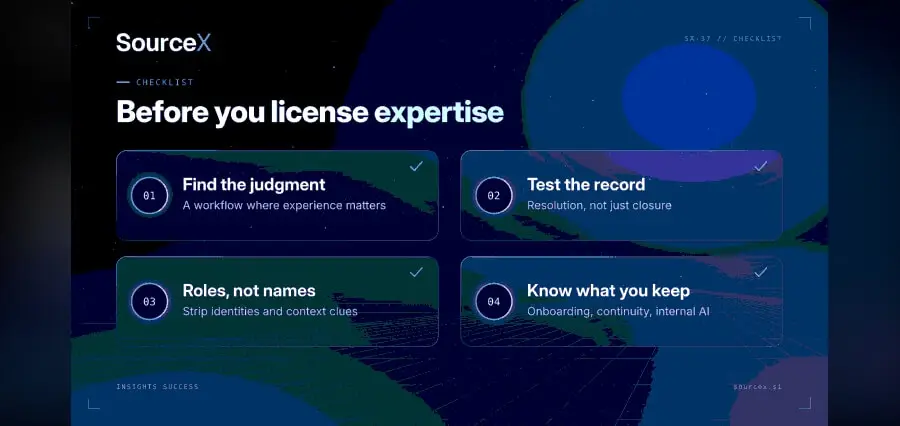
The asset is the work, not the people. Protect identities and decide what you’re keeping before you license.
How does a company license this kind of data?
SourceX pays businesses for approved work records for AI training and evaluation and contracts with the company directly. It manages qualification, the agreement, preparation and payout. Original records remain the company’s property. The selected data is exclusive for AI training for the agreed term; the separate grant over the deidentified dataset is perpetual, irrevocable, transferable and sublicensable, including products and onward distribution. Once the fee is paid, those rights survive termination and do not require models to be untrained or deleted.
The best fit is a company with several years of operating history that employed 50 or more people full time at its peak. SourceX’s advertised maximum of $4 million is reserved for the largest enterprise datasets; it is not a typical payout or an appraisal of your team’s expertise. Actual compensation is written into a signed deal.
The initial fit check uses a few company questions, with no record uploads or commitment. Extraction and delivery require the signed Master, a signed Dataset Deal Confirmation and SourceX’s go-ahead.
What should a leader ask the team this month?
Ask one question: “Where is our most important kind of judgment recorded, and what would an outsider need to understand it?” An inventory can answer that without sharing a single individual record. The answer may support a licensing conversation, sharpen your knowledge management or reveal expertise you should be preserving more carefully.
All three outcomes start the same way: taking your team’s decisions seriously enough to document them accurately.
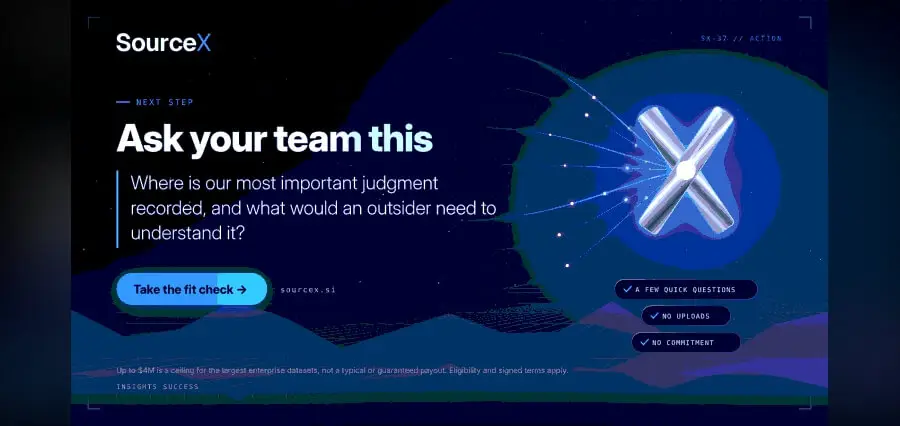
One question, answered with an inventory rather than individual records, is enough to start.
Bring that inventory to the leader authorized to consider a license. SourceX starts with a company fit check, with no record uploads or commitment. Decide what must stay excluded and how the proposed rights fit your own knowledge and AI plans before signing.
About the founder
Noah Loul is a four-time founder and the founder and CEO of SourceX, which licenses business data directly from companies for AI training and evaluation. He previously founded B2B Rocket, acquired by Blackpearl Group. His work focuses on building permission-based data infrastructure for AI.