Seventeen days after surgeons removed part of his right lung, Pope Leo XIV told a gathering of artificial intelligence researchers on Friday that the world no longer needs new ethical principles for AI. It needs institutions with the power to enforce the ones it already has.
The 71-year-old pontiff spoke at a one-day meeting held last month by the Pontifical Academy for Life and the Future of Life Institute, the AI safety nonprofit led by physicist Max Tegmark. He drew on Magnifica Humanitas, the encyclical on AI he released in May at a presentation that featured Anthropic co-founder Chris Olah.
Pope Leo’s sharpest warning concerned legal personhood. Granting rights to AI systems, he argued, would obscure human responsibility and leave people who are harmed with no one to confront.
Decisions touching life, freedom or the use of force must stay under informed human oversight, he said, and automated decisions should be open to examination, challenge and remedy.
Tegmark said he hoped the Vatican’s moral standing could influence how the technology is built.
A rival model in Washington
The address came a month after a very different approach took shape in the United States. In September President Trump and six frontier developers, OpenAI, Anthropic, Google, Meta, xAI and Nvidia, signed the White House Accord on Super Intelligence. The one-page voluntary pledge commits them to internal safety controls, independent audits and board-level oversight.
Trump described the pact as morally binding, but it carries no penalties for companies that fall short. Pressure for enforceable rules has come mainly from Congress. Pop Leo’s prescription runs nearly the opposite way: shared standards, independent oversight and clear accountability when systems cause harm.
A health scare and a full calendar
The pope announced on October 11 that doctors had found a nodule on his lung. Two days later, surgeons at Rome’s Gemelli hospital removed the lower lobe of his right lung and confirmed adenocarcinoma, the most common form of lung cancer. The Vatican has not disclosed the cancer’s stage.
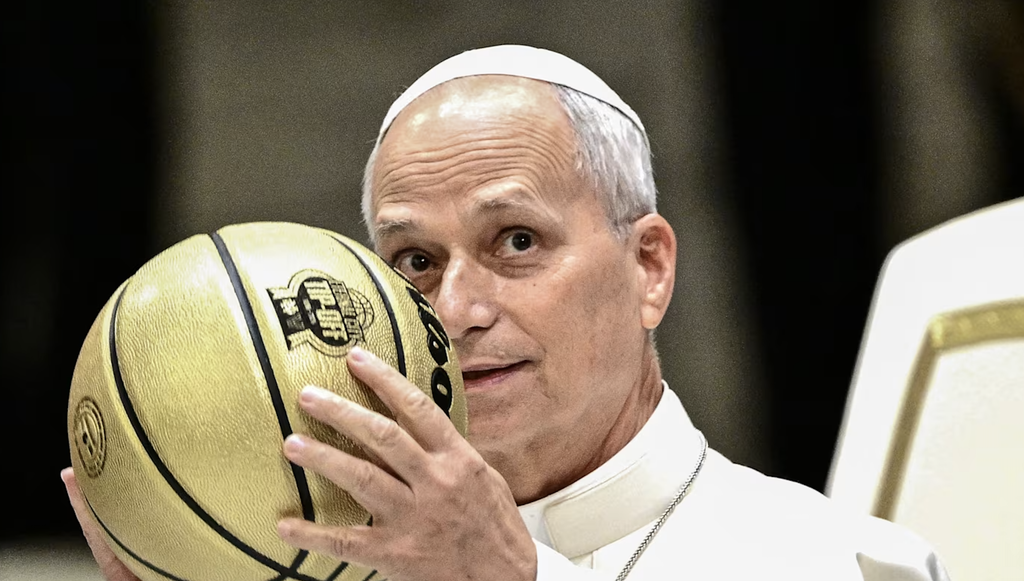
This past Saturday brought a lighter assignment, when the Pope hosted the Eternal City Tip-Off in St. Peter’s Basilica, the burial place of St. Peter and one of the most iconic sites in Christendom.
The event includes a Private Mass presided by The Most Reverend Nelson J. Pérez, Archbishop of Philadelphia, and joined in concelebration by Villanova University President Rev. Peter M. Donohue, OSA, and University of Notre Dame President Rev. Robert A. Dowd, C.S.C.
Founders in the crowd
Among the guests, according to The AI Journal, was Eddie Cullen, CEO of Crescite Innovation (article’s featured photo, photo credit: Massimo Digiovanna with MD Fotos).
Cullen has told EWTN News the pair started the company out of love for the Church.
His case for ethical finance, that a financial product should be judged by whom it serves as well as what it earns, echoes the pope’s insistence that new technology be directed toward the common good. It also captured an overlap in the hall: some of those cheering the pope on Saturday build the kind of systems he had, a day earlier, asked to be held to account.
What comes next
Pop Leo has few tools beyond persuasion, but he has used them steadily. He named AI a defining challenge in his first address to the cardinals in May 2025, set up a Vatican study group on the technology and made it the subject of his first encyclical.
His next stage is South America. He departs Friday on an 11-day trip to Uruguay, Argentina and Peru, where he spent decades as a missionary and bishop.