The next generation of unicorns may not originate in Silicon Valley, but in universities, where ambitious students are already turning research and ideas into startups.
When University of Miami alumni Angel and Victor Alvarez wrote a $5 million check to their alma mater in 2024, they weren’t backing an established company with customers and momentum. They were betting on students — most of whom didn’t have companies yet, just ideas.
Two years and 60 funded startups later, that bet is beginning to look prescient.
That investment launched the University Student Startup Accelerator (USTAAR), the University of Miami’s flagship program for turning student ideas into venture-backed companies.
USTAAR operates as a sequential process that spans the academic year. In the fall semester, student teams submit pitch decks and introductory videos as part of the application process. Twenty teams are selected to receive the Venture Catalyst Award, a $10,000 non-dilutive grant for prototyping and feasibility testing. Throughout the semester, teams work with USTAAR staff, faculty mentors, and business leaders to sharpen their ideas before advancing to the spring pitch competition.
There, the top five teams are awarded $100,000 equity investments each year. So far, 14 startups have secured that funding. In USTAAR’s third cohort, 10 additional teams with promising but early-stage ideas each received a $1,000 Ignite Award, to validate their ideas.
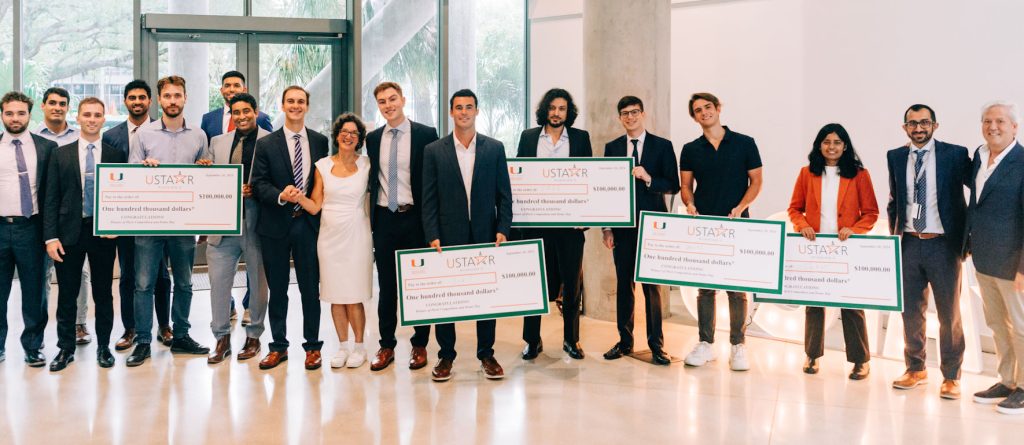
Like Stanford’s StartX and MIT’s delta v, USTAAR is building a pipeline of founders across biomedical engineering, AI, and fintech.
At its 2026 pitch showcase, second-year medical students, Eric Sokhn and Yasmine Mohseni, who returned after falling short the previous year, were among five teams awarded $100,000 each in seed funding.
Their startup, SkinSmart, is an app that uses artificial intelligence to analyze images of skin lesions for early signs of skin cancer. CEO Mohseni said it delivers “real-time AI risk stratification of concerning lesions, helping to improve early detection and prioritize high-risk patients.” The other winning teams showcased ventures ranging from an AI-powered fish tank, to a clinical documentation platform for healthcare providers.
USTAAR’s impact is undeniable. Whether it can help Miami close a long-standing gap is a different question altogether.
The Bay Area, New York and Boston have long dominated the US startup landscape, each anchored by universities that don’t just educate founders but produce them.
Miami has recently emerged as a serious contender. It ranked among the world’s top 20 startup ecosystems in Dealroom’s 2026 Global Tech Ecosystem Index, with the estimated enterprise value of its companies exceeding $670 billion — the fourth highest in the nation.
But a structural problem persists. Aoife Morrin, Dealroom’s Head of Ecosystem Growth calls it a “structural reflection of Miami being a destination ecosystem rather than a university-driven one.” In other words, Miami attracts founders, but produces relatively few through its own universities.
USTAAR is a direct attempt to change that. “USTAAR will ensure that our students have the resources, education, mentoring, and, most importantly, capital they need to bring their ideas forward and create a socioeconomic impact in South Florida and beyond,” said Dr. Suhrud Rajguru, the program’s director.
Featured image: Angel Alvarez
Image credit: USTAAR